China advances AI-driven trade strategy to strengthen global business ties
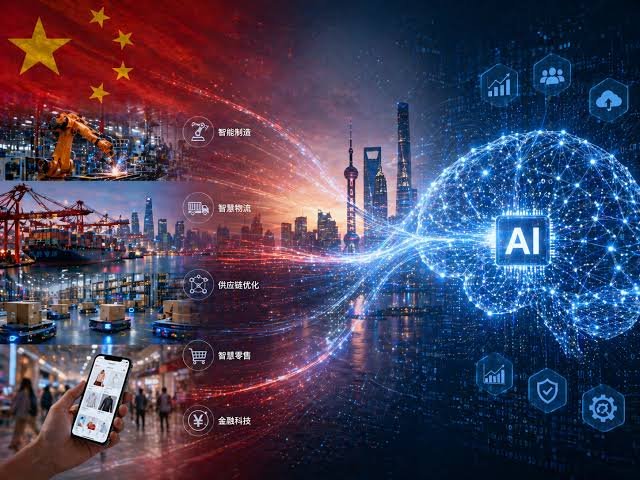
Islamabad Nov 19,2026: China’s latest initiative to integrate artificial intelligence (AI) into commerce is expected to improve business efficiency, strengthen supply chains and create new opportunities for international trade and technological cooperation.
Nine Chinese government departments jointly introduced 18 measures on Oct. 13 aimed at accelerating technology-driven innovation across major areas of commerce, including goods consumption, services consumption, commercial distribution, innovative business applications, the business technology environment and policy support.
According to China’s Ministry of Commerce, the initiative encourages businesses to adopt AI technologies in product research, design, manufacturing and marketing, alongside the development of smart warehouses, intelligent logistics systems, unmanned delivery services and digitally upgraded wholesale and retail operations.
The measures also promote AI shopping assistants, innovative commercial applications and virtual shopping experiences, reflecting China’s efforts to integrate advanced technologies across the commercial value chain.
Data from China’s National Bureau of Statistics (NBS) show that retail sales of consumer goods reached 37 trillion yuan during the first three quarters of 2026, increasing 1.1% year on year, while retail sales of services grew 5%.
Asif Javed, associate research fellow at the Sustainable Development Policy Institute (SDPI), told Wealth Pakistan that China’s AI-driven commerce strategy represented an important step in its broader efforts to transform the economy through technological innovation, intelligent manufacturing and digitalisation.
He noted that the initiative could generate substantial economic benefits through higher productivity, lower operating costs, more efficient supply chains, improved consumer experiences and the development of innovative business models.
Javed highlighted China’s approach as an example of how AI could be integrated across the commercial value chain, from product development and manufacturing to distribution and customer service.
Such integration could also strengthen connections between domestic industries and international markets, creating opportunities for businesses to participate in increasingly technology-driven global trade networks, he said.
China’s advancements in intelligent logistics, automated warehousing and digital commerce could offer particular benefits to international businesses by improving delivery efficiency, strengthening inventory management and reducing transaction costs.
These technologies could help companies respond more effectively to changing market demand while supporting smoother cross-border commercial operations and greater efficiency in international supply chains.
The expansion of AI-enabled commerce also presents opportunities for international cooperation in technology development, digital platforms, smart manufacturing and logistics services.
Businesses in developing and emerging economies could benefit from technology partnerships, investment and knowledge-sharing arrangements that support the modernisation of their commercial infrastructure and improve access to international markets.
Ihsan Ullah, regulatory modernisation specialist at the Board of Investment, Prime Minister’s Office, Islamabad, told Wealth Pakistan that the growing application of AI in commerce could make global trade faster, more efficient and increasingly accessible to businesses.
He said intelligent logistics systems, automated inventory management and supply chain forecasting could improve the efficiency of international trade by enabling businesses to better anticipate demand, manage shipments and coordinate commercial operations.
According to Ihsan, these applications could minimise delays, reduce transaction costs and strengthen international business connectivity, particularly as companies increasingly rely on digital technologies to manage cross-border trade.
He emphasised that partnerships, investment and knowledge transfer could help Pakistani businesses improve productivity, enhance export competitiveness and integrate more effectively into global value chains.
Ihsan identified several areas where Pakistan could benefit from China’s experience, including smart textile manufacturing, value-added agricultural exports, AI-enabled services and improved digital market access for small and medium-sized enterprises.
He said greater adoption of advanced technologies in logistics, food processing and e-commerce could help Pakistani businesses modernise operations, improve efficiency and strengthen their competitiveness in international markets.
China’s expanding integration of AI into commerce highlights the potential of technological innovation to improve economic efficiency and strengthen connections between domestic production systems and global markets.
For developing economies, the initiative also offers opportunities to explore technology partnerships and adopt digital solutions that could enhance trade competitiveness, modernise commercial infrastructure and support sustainable economic growth.